


Understanding Phonics
Phonics is the method of teaching children how written letters connect to spoken sounds. It looks simple from the outside, but inside a child’s brain, phonics activates several powerful learning systems at the same time. When a child sees a letter, the brain must recognize its shape, attach a sound to it, blend it with other sounds, and then turn all of that into a meaningful word. Phonics teaches children to do this step-by-step until their brain becomes fast and automatic at reading.
At its core, phonics teaches three main abilities. First is sound awareness, where children learn that words are made of smaller sound units, like /c/, /a/, /t/. Second is letter–sound matching, meaning they learn which letter or letter-combination creates which sound. The third is blending, where they push the sounds together to read a full word. Over time, these skills become so practiced that children stop sounding out letters one by one and begin reading whole words instantly.
Effective phonics also includes segmenting (breaking a word into sounds), manipulating sounds, recognizing patterns, and understanding spelling rules. For example, children learn that “ph” makes an /f/ sound, or “igh” makes a long /i/ sound. They start identifying word families, like light, night, sight, which helps them read new words more confidently. The purpose of phonics isn’t memorizing words, it’s teaching the brain how to decode any new word it sees.
Children who learn phonics early not only read faster but also develop a stronger foundation for spelling, writing, and comprehension. Because they understand how words work from the inside, they don’t get stuck guessing. Instead, they decode, blend, and understand with clarity.
How Phonics Builds the Brain’s Sound-Mapping System
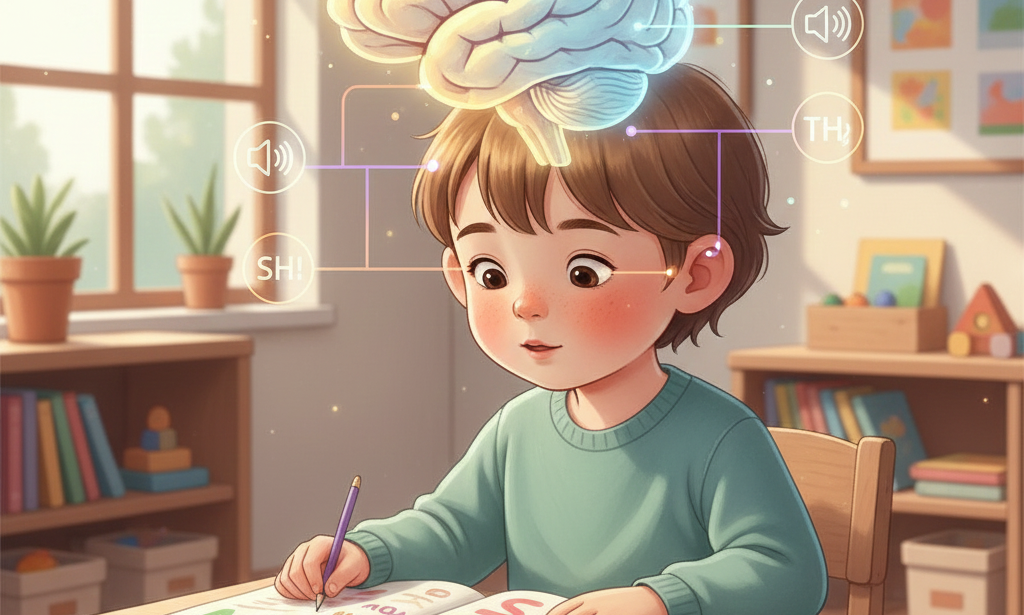
Phonics does more than teach reading skills, it literally strengthens how the brain maps sound, print, and meaning together. When a child practices connecting letters to sounds, neurons in the language areas of the brain form stronger pathways. Each time the child blends sounds, these pathways become faster and more efficient. Eventually, the brain builds an automatic “sound-mapping system” where letters immediately trigger the correct sounds without effort.
This is important because reading is not a natural human ability. The brain is not born with reading circuits; it must create them by rewiring existing language and visual areas. Phonics guides this rewiring process. By repeatedly linking print to sound, the child’s brain learns to recognize patterns, predict upcoming sounds, and process words rapidly. This is why strong phonics instruction often leads to quicker reading fluency.
Phonics also supports working memory. When children blend sounds, their brain learns to hold and combine small units of information. Over time, this strengthens cognitive flexibility, allowing them to read longer words, switch between spelling rules, and understand new vocabulary more easily.
Another major benefit is that phonics reduces the cognitive load during reading. Children who do not master sound mapping often guess words using pictures or first letters, which makes reading slow and tiring. In contrast, phonics-trained children decode smoothly, freeing their brain to focus on comprehension, imagination, and meaning.
Phonics also connects strongly to speech development. As children learn that sounds can be isolated, changed, or blended, their articulation improves. They become more aware of how sounds are produced and are better able to self-correct during speaking.
Conclusion
Phonics is not just a reading technique, it is a brain-training system. The first half of learning helps children understand how letters and sounds work together. The second half, where sound-to-print mapping grows stronger, transforms reading from a slow, effortful task into a fast, automatic skill. When children master phonics early, they build the strongest possible foundation for reading, writing, spelling, and lifelong learning.

You must be logged in to post a comment.