

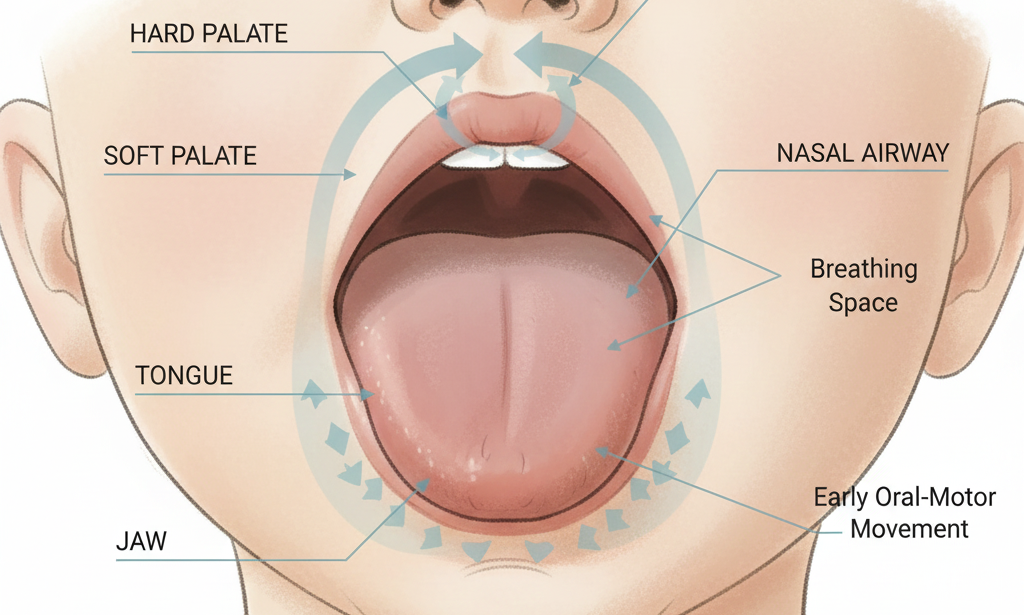

Macroglossia means an unusually large tongue, and while the condition often gets discussed in terms of feeding or speech problems, there is a much deeper story happening inside the child’s developing brain and face. The tongue is one of the most active muscles in infancy. It shapes how babies suck, swallow, breathe, explore textures, and eventually learn to speak. When the tongue is larger than normal, the brain receives very different sensory information, which changes how early movements, habits, and facial structures develop over time.
In simple terms, the tongue becomes a “boss muscle” in the mouth strong, heavy, and constantly pushing against nearby structures. That extra pressure and movement affects how the jaws grow, how the palate forms, and how the infant learns to coordinate feeding and breathing. These early changes can influence the child’s long-term oral patterns, even before speech begins.
Early Mouth Movements
Infants use their tongues for almost every oral task. With macroglossia, the large size limits free movement inside the mouth. The tongue may rest forward, push against the teeth, or make swallowing harder. Because the tongue fills so much space, the child may adopt different patterns to breathe, chew, or latch during feeding. These repeated adjustments teach the brain alternative ways to control the muscles. Over time, these altered patterns become part of the child’s natural behavior.
Sensory and Motor Signals Shape the Developing Brain
The tongue has thousands of sensory receptors that constantly send messages to the brain. When the tongue is larger, these messages change. The brain receives stronger pressure signals and different movement feedback. This affects how the brain builds its “map” of the mouth. Instead of typical tongue lifting or controlled shaping, the brain may learn to depend on the jaw, lips, or cheeks to help with tasks the tongue struggles with. This is the brain’s natural way of adapting, but it also means that some oral habits become harder to modify later in childhood.
Impact on Breathing, Palate Shape, and Orofacial Growth
A tongue that rests too forward or too high can affect airflow. Many infants with macroglossia breathe through their mouths because the tongue partly blocks nasal airflow. This breathing pattern influences how the face grows mouth breathing tends to narrow the palate and affect jaw alignment over time. The large tongue also presses against the palate during growth, sometimes widening it or preventing it from forming its ideal shape. These structural changes are a direct result of the tongue’s early position and movement.
Speech Development and Muscle Coordination
Speech requires precise tongue control. A larger tongue has more weight and less room to move, which makes certain sounds harder to form. Children may rely more on lips or jaw movements to compensate. This is not a lack of intelligence or ability it is simply the body adapting to a different starting point. With guidance, children learn clearer movement patterns, but understanding why these patterns formed helps professionals give better intervention.
importance of Early Support
The good news is that young children have very high brain plasticity. When support begins early through feeding guidance, oral-motor exercises, and correct tongue positioning children can build healthier movement habits. Helping a baby learn alternative but effective strategies prevents long-term difficulties and supports normal facial development.
Conclusion
Macroglossia does more than make the tongue bigger it reshapes how the mouth works and how the brain learns to control those movements. It influences breathing, feeding, oral habits, and even facial growth. Understanding macroglossia as both a physical and sensory-motor condition helps caregivers and professionals give better support. With early guidance, children can build strong, efficient oral-motor patterns and grow with confidence.

You must be logged in to post a comment.